Flexible, Vision-Guided Automation – Built for High-SKU Food Production
Overview Summary
- High-SKU food production is limited more by variability than speed
- Traditional automation struggles with frequent changeovers and mixed packaging
- Vision-guided robotics adapt in real time to product position and orientation
- Software-driven changeovers reduce downtime and operator intervention
- Flexible systems allow one cell to handle multiple SKUs and formats
- Integration can be phased into existing lines without full replacement
When SKU Variety Breaks Traditional Automation
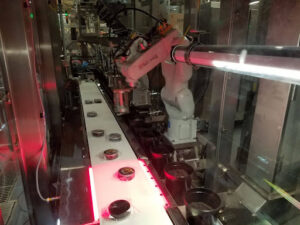 Many food production lines perform well under steady conditions. The challenge begins when SKU variety increases.
A line that once handled a few consistent products now needs to process a wide mix of packaging sizes, formats, and orientations. Operators step in to adjust staging, correct misaligned products, and manage changeovers. As a result, throughput slows and errors increase.
This is not a speed problem. It is a variability problem.
Traditional automation systems are designed for consistency. Food production rarely delivers that consistency, especially in high-mix environments.
Why Variability, Not Volume, Is the Real Bottleneck
In most food manufacturing environments, the limiting factor is not how fast equipment can run. It is how well the system handles change.
Common challenges include:
- Frequent SKU changeovers
- Mixed product sizes and packaging formats
- Inconsistent product presentation from upstream processes
- Dependence on manual decisions for picking and placement
To compensate, plants often:
- Add labor during changeovers
- Slow line speeds to reduce errors
- Segment production into longer runs
These approaches may stabilize operations temporarily, but they reduce flexibility and cap long-term throughput.
The Shift to Flexible, Vision-Guided Automation
Flexible automation systems are designed to operate in environments where variability is constant.
Instead of requiring precise, repeatable inputs, these systems use vision technology and adaptive programming to make decisions in real time.
Vision-Guided Picking Replaces Manual Intervention
Modern robotic systems equipped with 2D or 3D vision can:
- Identify product position and orientation dynamically
- Handle randomly presented items without precise staging
- Adjust and optimize pick paths automatically
This eliminates the need for operators to manually prepare each pick. In some applications, it also enables SKU changes without stopping the line, removing a major source of downtime.
Software-Driven Changeovers Reduce Downtime
In traditional automation setups, changeovers often require:
- Mechanical adjustments
- New tooling or guides
- Manual intervention
Flexible systems shift this process into software.
- Operators can switch between SKUs using:
- Recipe selection on a touchscreen
- Vision model changes
Pre-programmed logic tied to product types
This reduces changeover time from minutes to seconds, allowing production to keep moving even as product mixes change.
One System, Multiple SKUs
A key advantage of flexible automation is the ability to consolidate operations.
Instead of building separate stations for each product type, a single robotic cell can:
- Handle multiple product sizes
- Adapt to different packaging formats
- Transition seamlessly between runs
This is especially valuable in food production, where SKU counts continue to grow and production schedules shift frequently.
Redefining the Role of Labor
Manual picking directly ties labor availability to output.
Flexible automation changes that relationship.
In many implementations:
- Operators move from performing repetitive tasks
- To overseeing multiple automated cells
In comparable high-mix environments, one operator has been able to manage several production cells simultaneously after automation, improving both efficiency and labor utilization.
Where Flexible Automation Delivers the Most Value
Vision-guided systems are particularly effective in high-variability applications such as:
Mixed-SKU Case Packing
Handling different product sizes and configurations on the same line.
Randomized Product Picking
Managing items that arrive loosely organized or inconsistently oriented.
Secondary Packaging
Adapting to variability introduced by upstream processes.
Kitting and Assortment Packaging
Combining multiple product types into a single package.
In these environments, adaptability has a greater impact on performance than raw machine speed.
Integrating Automation Without Rebuilding Your Line
One of the most common concerns is how new automation will fit into existing operations.
Most facilities are working with:
- Existing packaging equipment, conveyors and layouts
- Legacy control systems
- Limited floor space
- Ongoing production requirements
The most effective approach is not to replace everything. It is to integrate strategically.
That typically involves:
- Designing systems around current equipment
- Phasing implementation to minimize disruption
- Testing solutions before deployment
This reduces risk and helps ensure that automation delivers value without introducing new operational challenges.
The Business Case: Throughput, Labor, and Risk
When applied effectively, flexible automation delivers measurable improvements in three key areas:
Throughput
- Fewer slowdowns during changeovers
- Reduced stoppages from picking errors
Labor
- Less dependence on hard-to-staff, repetitive roles
- Improved allocation of skilled employees
Risk
- Reduced ergonomic strain and injury exposure
- More consistent product quality
Perhaps most importantly, it creates more predictable output in environments where variability is unavoidable.
How Remtec Helps Manufacturers Adapt Without Disruption
For manufacturers evaluating automation, the biggest challenge is not understanding the technology. It is finding a way to apply it without disrupting production or taking on unnecessary risk.
Remtec Engineering specializes in designing and integrating flexible, vision-guided robotic systems that work within the realities of existing food production environments.
That includes:
- Identifying the highest-impact automation opportunities
- Designing systems that adapt to SKU variability
- Integrating with existing equipment and controls
- Phasing implementation to minimize downtime
Start With the Right Question
High-SKU food production does not require faster machines. It requires systems that can adapt without slowing down.
A practical starting point is simple: Where is variability currently forcing your team to rely on manual decisions?
That is often where flexible automation delivers the fastest return.
If you are evaluating automation for a high-mix food production line, Remtec can help you assess what is feasible, what is not, and how to move forward with confidence. Contact us today.