How Food & Beverage Manufacturers Are Turning Labor Shortages Into Throughput Gains
Overview Summary
- Labor shortages in food and beverage manufacturing are structural, not temporary
- End-of-line roles like packing and palletizing create the most frequent bottlenecks
- Automating high-turnover, injury-prone tasks stabilizes output across shifts
- Removing manual constraints often unlocks hidden production capacity
- Phased robotic integration reduces risk and minimizes disruption
- Plants that redesign processes, not just hiring strategies, gain long-term throughput advantages
Labor Shortages in Food & Beverage Manufacturing Are Now a Process Problem
 For many food and beverage plants, labor instability is no longer a seasonal disruption. It has become an operational variable that affects throughput, scheduling, and margins every day.
Packing lines run short-handed. Palletizing stations rely on overtime. Supervisors spend more time solving staffing gaps than improving performance.
The plants gaining momentum in this environment are not waiting for the labor market to rebound. They are redesigning their operations so production output no longer depends on consistently filling physically demanding, high-turnover roles.
The shift is practical, not futuristic. It starts with identifying where labor gaps create measurable throughput constraints.
Where Labor Gaps Create the Biggest Bottlenecks
In food and beverage manufacturing, the highest turnover often occurs in roles that are:
- Repetitive and physically demanding
- Located in cold, wet, or high-speed environments
- Entry-level positions with limited retention
- End-of-line functions such as case packing and palletizing
These positions are critical. When palletizing falls behind, upstream processes must slow down. When packing teams are understaffed, line speeds are adjusted to compensate.
What begins as a hiring challenge quickly becomes a capacity limitation.
Forward-thinking plants are reframing these roles not as HR issues, but as process design opportunities.
Why Robotic Packing and Palletizing Deliver Immediate Throughput Stability
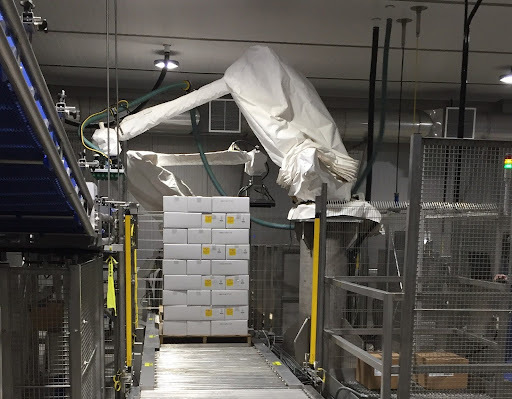
Across the industry, robotic case packing and palletizing are frequently the first automation projects approved. The reason is simple: the outcomes are measurable and operationally meaningful.
Consistent Output Across All Shifts
Robotic systems maintain predictable cycle times. They do not fatigue, call off, or require retraining when SKUs change.
Once commissioned and optimized, automated cells provide steady performance from first shift through third shift. That stability removes daily volatility and allows supervisors to focus on process improvement instead of staffing emergencies.
Bottleneck Elimination at the End of the Line
In many facilities, upstream equipment can run faster than manual palletizing teams can sustain.
When end-of-line automation removes that constraint:
- Existing assets operate closer to intended capacity
- Line speeds stabilize
- Unplanned slowdowns decrease
Often, the result is not dramatic expansion, but dependable output. In today’s labor climate, that consistency is a competitive advantage.
Reduced Dependence on Hard-to-Staff Positions
Instead of continuously hiring for repetitive lifting jobs, plants can redeploy team members to:
- Quality oversight
- Line monitoring
- Preventive maintenance support
- Higher-skill operational roles
This shift improves retention and morale while protecting throughput from staffing fluctuations.
The Safety Impact of Automating Injury-Prone Roles
End-of-line positions frequently involve repetitive lifting, twisting, and stacking. These motions contribute to strain injuries that affect scheduling, overtime, and workers’ compensation exposure.
When robotic systems assume the heaviest or most repetitive tasks:
- Injury risk decreases
- Absenteeism becomes more predictable
- Supervisory time spent managing coverage is reduced
For many facilities, safety improvements alone justify automation discussions before productivity gains are even included in ROI calculations.
A Phased Automation Strategy Reduces Risk
Most food and beverage manufacturers are not overhauling entire facilities at once. Instead, they take a phased, targeted approach.
Common starting points include:
- One high-volume palletizing station
- A repetitive case packing cell
- A SKU-rotation-heavy product line
Performance metrics are tracked before and after integration. Output stability, downtime, and labor allocation are measured carefully.
This measured rollout allows engineering leaders to build internal confidence, validate ROI, and reduce resistance from operations or finance stakeholders.
Automation as Risk Reduction, Not Headcount Reduction
The most successful plants do not approach automation as a workforce replacement strategy. They treat it as risk mitigation.
The objective is to:
- Remove dependence on positions that are consistently difficult to fill
- Prevent production slowdowns caused by staffing gaps
- Protect operators from physically demanding tasks
- Increase output without scaling labor one-to-one
When automation supports these goals, throughput gains become a byproduct of operational stability.
A Practical Benchmark for Your Facility
If you evaluate your own plant honestly, consider:
- Which position is hardest to keep staffed?
- Where does staffing instability affect output most?
- Which roles generate the highest overtime costs?
In many food and beverage facilities, the answers point directly to packing and palletizing. That is why so many peer manufacturers are beginning their automation journey there.
How Remtec Supports Food & Beverage Automation Initiatives
For facilities ready to explore automation in packing, palletizing, or other high-turnover roles, success depends heavily on integration strategy.
Remtec works with food and beverage manufacturers to design and implement robotic automation systems that:
- Integrate with existing equipment and legacy systems
- Minimize production disruption during installation
- Provide clear ROI modeling and phased implementation plans
- Include operator training and long-term support
With proven expertise in industrial robotic integration, including Fanuc robotic systems, Remtec helps plants move from labor pressure to measurable throughput gains without unnecessary complexity.
Turning Labor Pressure Into Operational Strength
Labor shortages are unlikely to disappear in the near term. Facilities that focus solely on hiring strategies will continue to experience instability.
Plants that redesign their most vulnerable processes are achieving something more powerful: steady output, fewer bottlenecks, and improved safety.
If you are evaluating where automation can deliver the most immediate impact in your facility, Remtec can help you assess your highest-risk roles and build a practical integration roadmap.
Contact Remtec to discuss how robotic packing and palletizing automation can strengthen throughput in your food and beverage operation.