Remtec Introduces Collaborative Palletizing Systems For PACK EXPO 2026
Key Takeaways
- Remtec is introducing Collaborative Palletizing Systems as a new addition to its robotic automation offerings.
- Collaborative palletizers provide a more standardized approach to automating repetitive end-of-line palletizing tasks.
- These systems can reduce engineering complexity, shorten implementation timelines, and minimize disruption to existing production operations.
- FANUC collaborative robots can support flexible palletizing applications involving multiple case sizes, SKUs, and pallet patterns.
- Collaborative palletizing can help manufacturers address labor challenges, improve consistency, and reduce physically demanding manual handling.
- Visitors to PACK EXPO 2026 can learn more about Remtec’s new systems and discuss their specific palletizing applications with the Remtec team.
A Practical Approach to End-of-Line Automation
 For many manufacturers, palletizing is one of the most obvious opportunities for automation. It is also one of the most challenging positions to keep consistently staffed.
Manually lifting, positioning, and stacking cases is repetitive, physically demanding work. As production volumes increase, palletizing operations must keep pace to prevent bottlenecks that affect the entire line.
Robotic palletizing offers a proven way to address these challenges. However, manufacturers sometimes hesitate to pursue automation because of concerns about equipment costs, installation timelines, floor space, and integration with existing production systems.
Collaborative robotic palletizing systems offer another option. By combining established robotic technology with a more standardized system design, these solutions can make end-of-line automation more practical for manufacturers that do not require a highly customized robotic cell.
Recognizing this opportunity, Remtec is introducing a new line of Collaborative Palletizing Systems for PACK EXPO 2026.
What Is a Collaborative Robotic Palletizing System?
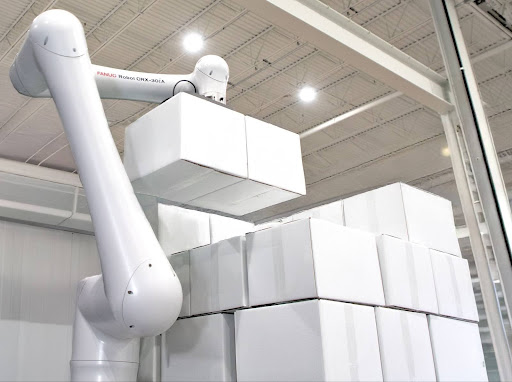
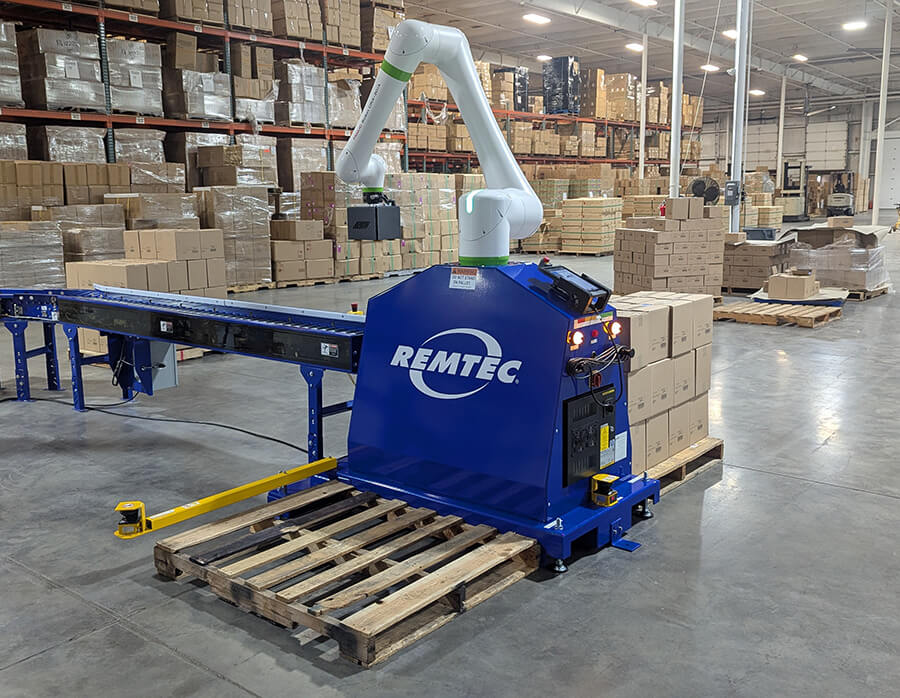
A collaborative robotic palletizing system uses a collaborative robot, commonly called a cobot, to pick finished cases or products from a conveyor and arrange them onto pallets according to programmed stacking patterns.
A typical system combines:
- A collaborative robotic arm
- End-of-arm tooling specifically designed for the products being handled
- Palletizing software and controls
- Appropriate safety components
- A system layout configured for the manufacturer’s production requirements
Unlike a fully custom robotic palletizing installation, a standardized collaborative palletizing platform begins with an established system design that can be configured for a defined range of applications. This approach can reduce the engineering and customization required to move from initial planning to installation.
Importantly, collaborative operation does not automatically mean a robot can operate without guarding or other protective measures. Appropriate safety requirements depend on the application, robot movements, payload, tooling, and surrounding equipment.
Why Collaborative Palletizing Makes Sense for Many Manufacturers
Faster Implementation with Less Engineering Complexity
One of the primary advantages of standardized collaborative palletizing systems is the potential to reduce project development time.
Traditional robotic palletizing cells may require extensive engineering, fabrication, programming, and integration. While that level of customization is necessary for some applications, it may be more than a straightforward palletizing operation requires.
A standardized collaborative system provides an established starting point. Rather than designing every element from scratch, the system can be configured around the manufacturer’s case dimensions, pallet patterns, production rates, and available floor space.
This can simplify project planning and help manufacturers implement automation more quickly.
Integration with Existing Production Lines
Manufacturers are understandably concerned about how a new automation system will affect their existing operations. Collaborative palletizing systems can often be incorporated into established end-of-line processes without the extensive facility modifications associated with larger robotic cells.
Depending on the application, a compact system footprint may also make collaborative palletizing attractive where floor space is limited. The objective is to automate the palletizing operation while preserving as much of the surrounding production infrastructure as practical.
Greater Flexibility for Multiple Products and SKUs
Many manufacturing facilities handle multiple products, case dimensions, and pallet configurations throughout the production day. Collaborative palletizing systems can be programmed with different palletizing recipes, allowing operators to select appropriate stacking patterns as production requirements change.
This flexibility is particularly valuable in food, beverage, and consumer goods manufacturing, where product variety and frequent changeovers can complicate end-of-line operations. The system must still be properly configured for the range of products it will handle, but programmable pallet patterns can reduce the need for manual adjustments between production runs.
The Benefits Go Beyond Labor Savings
Reducing the labor required for manual palletizing is often a major reason manufacturers investigate robotic systems. However, the potential benefits extend beyond direct labor costs.
Collaborative palletizing automation can help manufacturers:
- Reduce repetitive lifting, reaching, and twisting associated with manual palletizing
- Maintain more consistent pallet stacking patterns
- Reduce dependence on staffing difficult-to-fill positions
- Support more predictable end-of-line throughput
- Reassign employees to higher-value production activities
- Reduce the risk of palletizing becoming a bottleneck during busy production periods
For manufacturers evaluating return on investment, the complete picture should include labor utilization, production consistency, ergonomic considerations, and the operational consequences of an understaffed palletizing station.
These factors can make palletizing a practical starting point for facilities beginning their automation journey.
Is Collaborative Palletizing Right for Every Application?
Although collaborative palletizing offers significant advantages, it is not the best solution for every manufacturing operation. Applications involving very heavy products, high production rates, unusual packaging, or complex palletizing requirements may be better suited to conventional industrial robots and customized palletizing cells.
Before selecting a system, manufacturers should evaluate:
- Product dimensions and weights
- Required cases per minute
- Pallet dimensions and stacking patterns
- Number of products and frequency of changeovers
- Available floor space
- Existing conveyor and material handling equipment
- Safety and operator access requirements
The objective is not simply to install a collaborative robot. It is to select the most reliable, efficient, and cost-effective automation solution for the application.
Introducing Remtec’s Collaborative Palletizing Systems at PACK EXPO 2026
Remtec is expanding its robotic automation offerings with a new line of Collaborative Palletizing Systems designed to provide manufacturers with a more straightforward approach to end-of-line automation.
Built around FANUC collaborative robotic technology, these systems combine the benefits of a standardized palletizing platform with Remtec’s experience in FANUC robotic integration.
For 45 years, Remtec has helped manufacturers implement robotic solutions for palletizing, packaging, material handling, and other production applications.
Our new collaborative palletizing systems build on that experience by offering a practical option for manufacturers seeking to automate common palletizing tasks without the complexity of a fully customized robotic installation. Because every production environment is different, our team evaluates each application to determine whether a collaborative palletizer or a more traditional robotic system is the appropriate choice.
Contact Remtec at PACK EXPO 2026
If you’re attending the show, we invite you to connect with our team to learn more about the systems and discuss your end-of-line automation needs. To make the conversation productive, consider a few basic details about your application, including case sizes, product weights, production rates, pallet patterns, and available floor space.
Planning to attend PACK EXPO? Connect with Remtec to learn how our new Collaborative Palletizing Systems could simplify your next automation project.
Can’t make it to the show? Contact Remtec to discuss your palletizing application and explore the options available for your facility.